
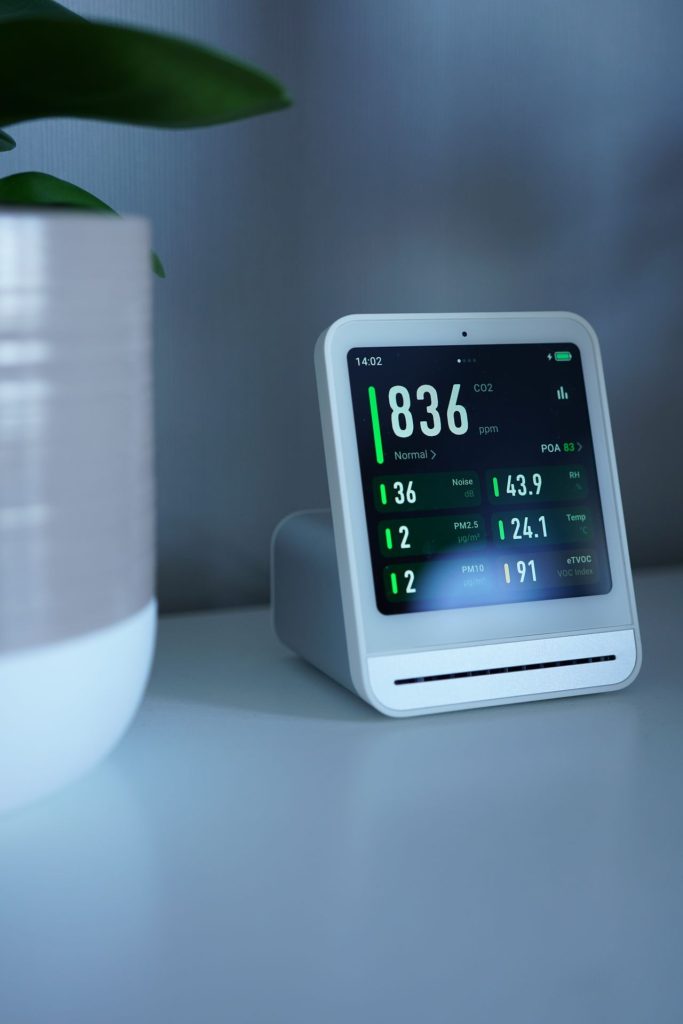
Walk into a house and you can usually spot obvious problems: a dripping faucet, a damaged roof shingle, or a crack in the foundation. Indoor air quality is different. Many of the things that affect the air inside a home cannot be seen, smelled, or noticed until they become a larger concern.
That is where an indoor air quality monitor can be useful.
What Does an Air Quality Monitor Do?
Home air quality monitors are designed to measure specific conditions in the indoor environment. Depending on the device, it may track fine particles, carbon dioxide, volatile organic compounds, temperature, or relative humidity.
Some monitors can reveal interesting patterns. Cooking, for example, can cause a temporary increase in airborne particles. Showering may send humidity levels upward. A crowded room with limited ventilation can produce higher carbon dioxide readings.
Seeing those changes can give homeowners a better understanding of how the house responds to normal daily activities.
Humidity Deserves Special Attention
For homes in North Carolina, humidity is one measurement worth watching.
Warm, damp weather can place additional demands on air-conditioning systems and make moisture management an important part of maintaining a home. Indoor humidity that remains elevated for extended periods can contribute to condensation and create conditions favorable to mold and other moisture-related problems.
A monitor can help identify a recurring pattern before there are obvious signs on walls, ceilings, or trim.
That does not mean a particular humidity reading automatically proves there is a problem. The construction of the home, season, ventilation, temperature, and other factors all matter.
Don’t Confuse Monitoring With Testing
This is probably the most important point for homeowners considering a purchase.
A consumer air quality monitor is primarily a screening and trend-tracking device. It can tell you that something changed, but it may not tell you exactly why.
For example, an elevated particle reading could have several possible explanations. Cooking, dust, outdoor air entering the home, fireplace use, or other activities may all affect the measurement.
Likewise, a sensor detecting elevated VOCs does not necessarily identify which substance is responsible.
When readings consistently look unusual, the appropriate response is investigation—not panic.
Is Buying One a Good Idea?
For homeowners who enjoy keeping an eye on their property’s condition, an air quality monitor can be a practical addition to the home.
It is particularly useful for establishing normal indoor conditions and noticing changes over time. However, it should be viewed as one piece of information rather than a substitute for proper ventilation, HVAC maintenance, moisture control, smoke alarms, carbon monoxide alarms, or professional evaluation when concerns arise.
Think of an air quality monitor as an early-warning tool. It may not provide all the answers, but it can help point out when a closer look is warranted.
And when it comes to a home, noticing a developing issue early is often far easier—and less expensive—than dealing with the consequences later.